In the rapidly advancing energy landscape of 2026, building the "Super Grids" of tomorrow requires more than just heavy machinery. It demands a sophisticated blend of digital precision, environmental stewardship, and advanced engineering. For an industry leader like Ampere Grid Co, High Voltage Transmission Line Construction is a meticulous seven-stage journey that transforms raw geographical data into a resilient backbone for the national power grid.
Whether you are an infrastructure developer or a policy-maker, understanding this lifecycle is key to ensuring project success in an era defined by renewable energy integration and smart-grid technology.
1. Route Selection and Digital Surveying
The first stage is no longer just about maps; it's about Digital Twins. Engineers at Ampere Grid Co use high-resolution LiDAR and drone-assisted mapping to analyze topography, soil health, and environmental impact. This ensures the shortest, most cost-effective route while strictly avoiding sensitive ecological zones and minimizing Right-of-Way (ROW) hurdles.
2. Foundations and Geotechnical Engineering
A tower is only as strong as the earth beneath it. Depending on the soil analysis, foundations are either Bored Cast-in-Situ Concrete Piles (for marshy ground) or Rock Anchors (for hilly terrain). In 2026, we utilize specialized sensors within the concrete to monitor curing and structural integrity in real-time, ensuring a foundation that lasts over 50 years.
3. Tower Assembly (Ground-Level Bolting)
Lattice steel towers are the most common choice for high-voltage lines due to their immense strength-to-weight ratio. At this stage, the tower "legs" and "braces" are pre-assembled on the ground by skilled riggers. Modern modular techniques allow Ampere Grid Co to pre-assemble large sections off-site, significantly reducing on-site construction time and local noise pollution.
4. Tower Erection (The Skyward Lift)
Using heavy-duty telescopic cranes or, in remote areas, specialized helicopter lifts, the pre-assembled sections are raised and bolted into place. This is a critical safety phase where high-altitude workers ensure every joint meets precise torque specifications to withstand 2026’s extreme weather patterns and wind loads.
5. Insulator and Hardware Installation
Once the towers stand tall, insulators—usually made of high-strength composite polymers or traditional porcelain—are attached to the cross-arms. These insulators are the "guards" of the grid, preventing high-voltage current from jumping to the steel structure. At this stage, vibration dampers and corona rings are also installed to ensure a quiet, efficient line.
6. Conductor Stringing (The Power Link)
This is the most visible stage of High Voltage Transmission Line Construction. Using a "Puller-Tensioner" system, heavy cables—often HTLS (High-Temperature Low-Sag) conductors—are unspooled and pulled through pulleys across the towers. This technology allows the lines to carry double the power of older cables without sagging dangerously low toward the ground.
7. Energization and Final Restoration
The final stage involves rigorous testing and "Hot-Line" checks to ensure zero leaks or faults. Once the system is energized, Ampere Grid Co focuses on site restoration—replanting native flora and ensuring the land beneath the lines is returned to a stable, usable state.
Why Choose Ampere Grid Co for High Voltage Transmission Line Construction?
When undertaking a project of this scale, the partner you choose determines your grid's reliability for the next half-century. Ampere Grid Co has become the gold standard in the industry for three main reasons:
- Integrated EPC Expertise: We handle everything from initial environmental clearances to final energization, providing a seamless, single-window solution.
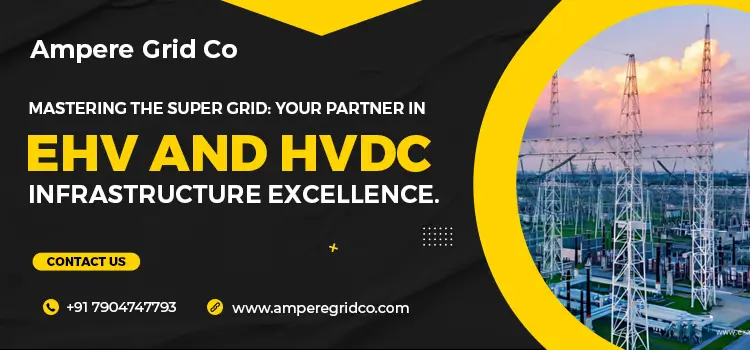
- Technological Mastery: We specialize in 765kV EHV (Extra High Voltage) and HVDC (High Voltage Direct Current) links, utilizing the latest 2026 stringing technologies that reduce energy loss by up to 15%.
- Zero-Harm Safety Culture: Our construction teams are trained in global safety standards, utilizing AI-driven hazard detection and drone monitoring to ensure that every project site remains accident-free.
Empowering the Future
Building a transmission line is an act of nation-building. It is the vital link that ensures the clean energy generated today reaches the homes and industries of tomorrow. With Ampere Grid Co, you aren't just getting a construction contractor; you are gaining a partner dedicated to engineering excellence, safety, and a sustainable energy future.
FAQ: High Voltage Transmission Line Construction
1. What is the typical timeline for High Voltage Transmission Line Construction?
In 2026, a standard 100km line can take between 18 to 36 months. This includes the time needed for environmental permits, material procurement, and the physical seven stages of construction. Ampere Grid Co utilizes project-management AI to optimize these timelines, often finishing 10% ahead of schedule.
2. How does Ampere Grid Co manage environmental impact during construction?
We employ a "Low-Impact Installation" philosophy. This involves using existing access roads wherever possible, employing drone-based surveying to avoid tree cutting, and utilizing specialized "Green Foundations" that require less concrete and produce a lower carbon footprint.
3. Why is HVDC becoming more popular for transmission lines in 2026?
HVDC (High Voltage Direct Current) is the "Gold Standard" for long-distance power transfer. Unlike AC lines, HVDC has significantly lower power losses over distances exceeding 500km and is essential for connecting remote offshore wind farms or desert solar arrays to urban centers.
4. What safety standards are followed during tower erection?
We strictly adhere to IS/IEC standards and OSHA-compliant fall protection systems. Every rigger at Ampere Grid Co is equipped with smart-wearables that monitor vital signs and height-safety clip-ins, ensuring maximum protection during high-altitude work.
5. Can existing transmission lines be upgraded without building new towers?
Yes. This is called Re-conductoring. By replacing old cables with modern HTLS conductors, Ampere Grid Co can help utilities double their power capacity using existing tower structures, saving millions in capital expenditure and avoiding new ROW conflicts.