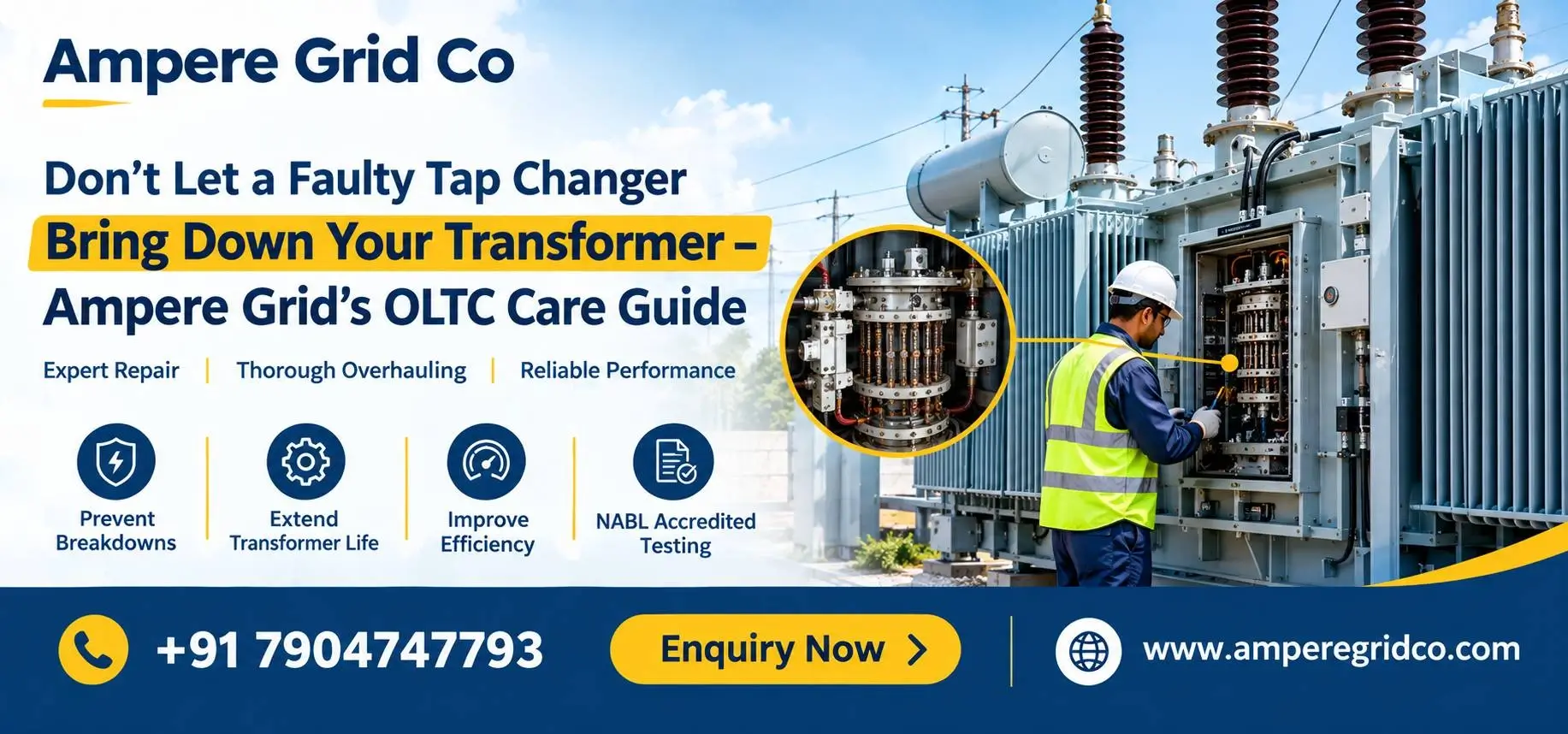
Inside every power transformer, the on-load tap changer, or OLTC, is the one component that never stops moving. It is constantly shifting tap positions to regulate voltage while the transformer stays live and connected to the grid, and that constant mechanical and electrical activity makes it one of the most failure-prone parts of the entire unit. Industry studies consistently show that a large share of transformer breakdowns can be traced back to OLTC problems, from worn contacts to sluggish drive mechanisms. This is exactly why a dependable transformer OLTC repairing service is not a luxury but a necessity for any utility, industry or commercial facility that depends on uninterrupted power. In this guide, Ampere Grid breaks down what OLTC maintenance actually involves, the warning signs to watch for, and how professional overhauling keeps your transformer running reliably for years.
Why Transformer OLTC Repair Service Matters
The on-load tap changer is the only moving part inside a power transformer, and that mechanical activity comes at a cost. Every tap change generates a small switching arc that gradually carbonises the surrounding oil and wears down the selector and diverter contacts. Over time, this leads to increased contact resistance, erratic transition timing and, in the worst cases, unplanned transformer trips. A timely transformer OLTC repairing service addresses this wear before it escalates into a full transformer failure, protecting both the equipment and the continuity of power supply to your plant, substation or commercial building.
Common Warning Signs That Call for On Load Tap Changer Maintenance
Certain red flags should never be ignored when it comes to on load tap changer maintenance. Rising contact resistance, unusual noise during tap operation, abnormal dissolved gas readings in oil analysis, and delayed or incomplete tap transitions are all early indicators of a developing fault. Frequent tripping of the buchholz or pressure relief relay, discoloured or contaminated oil inside the tap changer compartment, and a motor-drive mechanism that feels stiff or hesitant during operation are further signs that the OLTC needs professional attention rather than a temporary workaround.
What a Professional Transformer Overhauling Service Includes
A structured transformer overhauling service goes well beyond a quick visual check. It typically begins with the transformer being safely de-energised and earthed, followed by oil testing and draining from the tap changer compartment. Technicians then clean the internal components, inspect and replace worn selector and diverter contacts, check transition resistors, and examine the motor-drive mechanism for lubrication and calibration issues. The gearbox, shafts and pressure relay are tested, fresh filtered oil is filled, and the unit undergoes an operation test before being returned to service. Ampere Grid follows this full sequence for transformers up to 400KV, backed by NABL-accredited oil testing to confirm the health of the equipment before and after the work.
Benefits of Regular OLTC Maintenance Over Reactive Repair
Waiting for an OLTC to fail outright is a costly approach, both in terms of downtime and the risk of collateral damage to the main transformer winding. Scheduled on load tap changer maintenance, carried out roughly every few years or after a set number of tap operations as recommended by the manufacturer, allows contact wear to be tracked and worn parts replaced before they cause a bigger problem. This proactive approach reduces the frequency of emergency breakdowns, extends the working life of the transformer, and is almost always more economical than an unplanned outage and rush repair.
Why Choose Ampere Grid for Transformer OLTC Repairing Service
Ampere Grid specialises in manufacturing, repairing, rewinding, overhauling and testing transformers up to 400KV, along with dedicated OLTC repair, erection, commissioning and rental services. The team has handled breakdown and special maintenance work for transmission lines and transformers for clients including TNEB and TANTRANSCO, and every job is supported by NABL-accredited oil testing to verify equipment condition with data, not guesswork. Whether you need a one-time emergency repair or a scheduled transformer overhauling service as part of your annual maintenance plan, Ampere Grid's Chennai-based team brings hands-on experience with high-voltage transformer systems across Tamil Nadu.
Planning Your OLTC Maintenance Schedule
Manufacturers typically recommend an overhaul once the tap changer reaches a defined number of operations, or at a fixed interval such as every five to seven years, whichever comes first. Keeping a simple log of tap operation counts and periodic oil test results makes it far easier to plan maintenance proactively instead of reacting to a fault. Facilities with high tap-change frequency, such as those with fluctuating industrial loads or renewable energy integration, should consider shorter inspection intervals, since their OLTCs will accumulate wear faster than those on steadier loads.
Wrapping Up
The on-load tap changer may be a small part of the overall transformer, but its condition has an outsized impact on reliability. A structured transformer OLTC repairing service, backed by proper testing and experienced technicians, is the most effective way to avoid unplanned outages and protect a costly asset. Ampere Grid brings the technical depth and field experience needed to keep your transformers, and your power supply, running smoothly.
Frequently Asked Questions
1. What is included in a transformer OLTC repairing service?
It typically includes oil testing and draining, cleaning of internal components, contact inspection and replacement, motor-drive mechanism checks, and a full operation test before the transformer is returned to service.
2. How often should on load tap changer maintenance be carried out?
Most manufacturers recommend an overhaul every five to seven years or after a set number of tap operations, whichever comes first, though high-usage transformers may need more frequent checks.
3. What are the signs that a transformer needs OLTC repair?
Rising contact resistance, unusual noise during tap changes, abnormal dissolved gas readings, delayed transitions and frequent relay tripping are common warning signs.
4. Does Ampere Grid handle transformers of all voltage levels?
Ampere Grid repairs, overhauls and tests transformers up to 400KV, including OLTC repair, erection, commissioning and rental services.
5. Why is regular OLTC maintenance better than waiting for a breakdown?
Scheduled maintenance catches contact wear and mechanical issues early, reducing the risk of unplanned outages and typically costing far less than an emergency repair after failure.